Throughout years of designing interconnected web platforms and automating content workflows, I’ve relied on one universal truth: systems talk to each other through APIs. For decades, APIs have been the predictable, reliable glue holding our digital infrastructure together.
But as we transition from building software strictly for humans to building systems powered by Artificial Intelligence (AI), that traditional glue is starting to show its limitations.
There is a new standard rising fast in the tech landscape called the Model Context Protocol (MCP). It represents the biggest shift in system architecture since the invention of the API itself. If you are looking to understand how AI will interact with your business’s data, tools, and platforms in the near future, you need to understand MCP.
Here is a breakdown of why traditional APIs are struggling, what MCP actually is, and how it will change the way we work.
The Old Standard: Why Traditional APIs Struggle with AI
To understand the solution, we first have to understand the problem.
APIs (Application Programming Interfaces) were designed for programs talking to other programs. They are deterministic systems: you define an endpoint, send a highly structured request, and get a predictable response back.
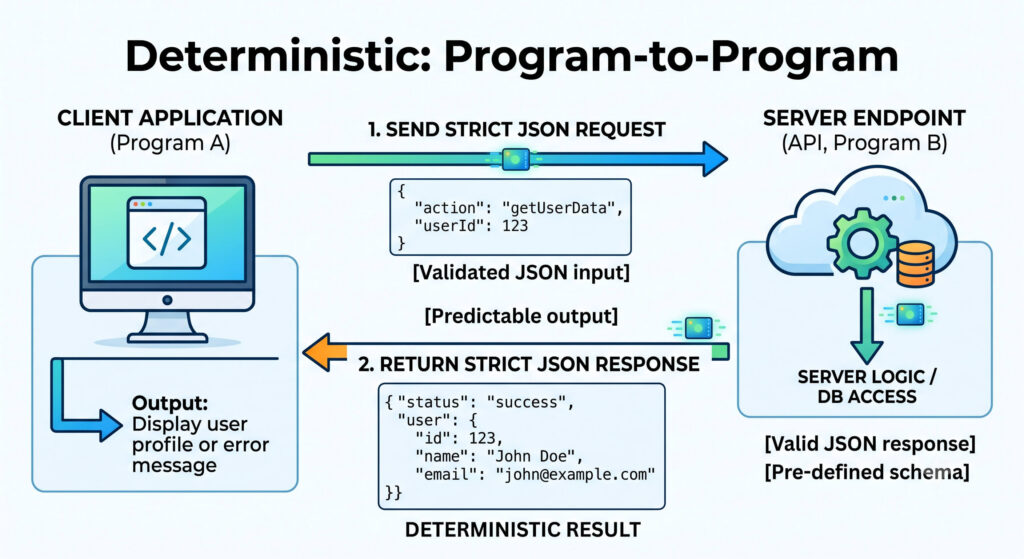
When we introduce Large Language Models (LLMs) into this equation, the foundation cracks. Models are probabilistic; they reason over messy, real-world data and often need to ask follow-up questions or chain multiple tools together to find an answer.
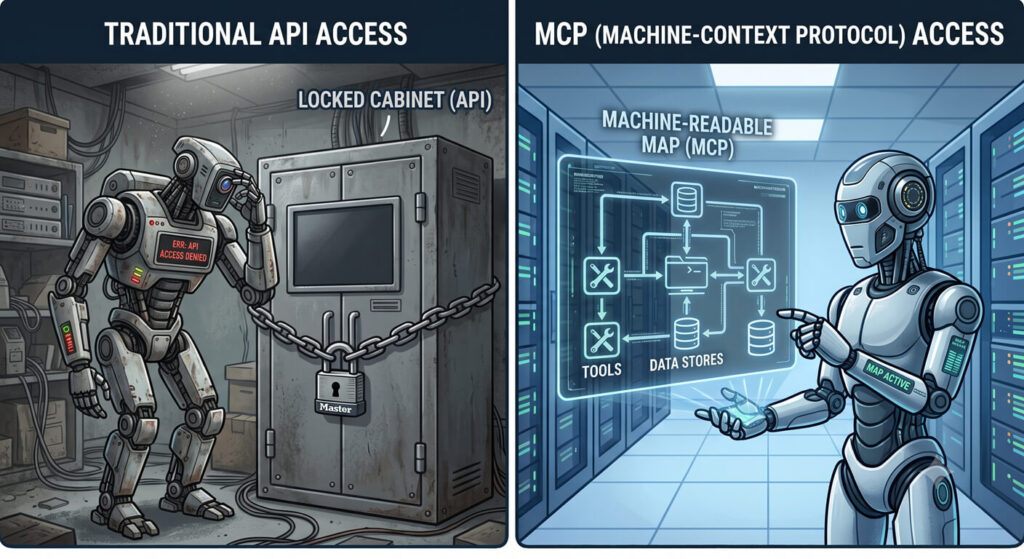
Think of a traditional API like a locked cabinet. To get what you want, you need to know exactly which drawer to open and what shape the key must be. A language model, however, is trying to understand what is inside that cabinet without any clear labels. Because APIs lack semantic context, developers have been forced to write massive amounts of custom “glue code” and highly fragile prompts just to teach the AI which endpoint to hit and what parameters to pass.
Enter the Model Context Protocol (MCP)
Introduced by Anthropic and rapidly gaining industry-wide adoption, the Model Context Protocol is an open standard designed to connect models to tools, data, and environments safely and reliably.
If an API is a locked cabinet, MCP is a live, machine-readable map of that cabinet.
MCP flips the traditional integration assumption. Instead of manually teaching the AI how to use a tool, MCP provides a standardized way for the model to autonomously discover what a tool can do, what inputs it expects, and what outputs it will return.
How MCP Works Under the Hood
The protocol defines a clear relationship between two sides: Clients and Servers.
- The Client: This is the AI model or agent (such as Claude or Gemini) that wants to perform a task.
- The Server: This is the environment holding your data or tools—whether that is a local database, a file system, or enterprise software like Google Workspace or BigQuery.
When the model (Client) connects to the data source (Server), the server advertises its capabilities using a structured, self-describing JSON schema. The server essentially says, “Here are the tools I have, here are the data resources you can read, and here is the context you can use”.
Because the communication relies on this standardized schema, the AI model knows exactly how to interact with the environment without a developer having to hardcode the integration. It allows for a clean separation of concerns: the AI handles the reasoning layer, while the MCP server handles the tooling layer.
MCP vs. API: It’s Not a Competition
A common misconception is that MCP will replace APIs. It will not. APIs are still the foundational way our systems function.
Instead of replacing APIs, MCP acts as the middleware between the AI model and your existing APIs. It acts like a translator, converting your traditional API endpoints into a semantic format that models can naturally understand.
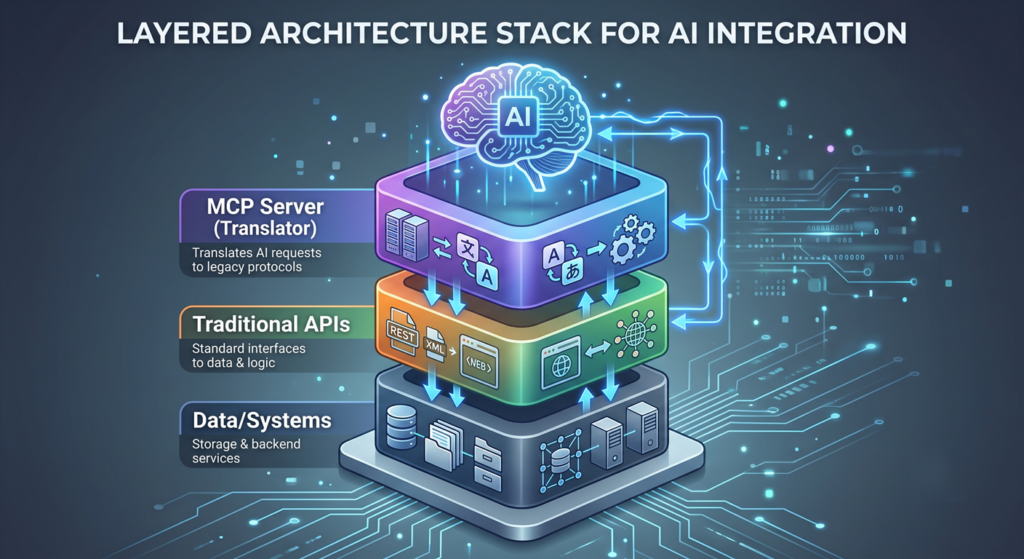
The fundamental difference lies in who the client is. With an API, the client is another piece of code. With MCP, the client is the model itself.
What This Brings to the Table
This shift from rigid code-level contracts to semantic protocols unlocks massive potential for how we build and scale technology.
- True Interoperability: Think of MCP as the “HTTP moment” for AI. Just as HTTP unified the internet and allowed different systems to communicate seamlessly, MCP provides a single open protocol that any compliant model can understand.
- The End of Custom Integrations: Today, if you want your AI assistant to check a calendar, read emails, and update a CRM, you have to build and maintain bespoke integrations for every single platform. With MCP, you build one interface, and any compatible AI model can use it instantly.
- Advanced Agentic Workflows: Because MCP standardizes tool access, we can now build multi-agent systems where different AI agents collaborate seamlessly. For example, a system can be designed where a “researcher” agent securely pulls live data from an MCP server connected to a database, and a “formatter” agent translates that data into a user-friendly report, all without hardcoded routing.
Final Thoughts
We are moving toward a shared ecosystem where AI models are no longer just software features; they are becoming first-class users of our digital platforms.
MCP is the plug-and-play layer making this possible. By turning static API routes into living interfaces that AI models can reason about, MCP is paving the way for software that is truly model-aware. For those of us building the next generation of digital experiences, adopting this paradigm shift early isn’t just an advantage—it will soon be a necessity.